
Contacts
Package: BASIC
1. General
The Contacts module is used to record natural persons. In addition to personal data such as name, address, email and phone, all relationships to records from other modules are also stored here – e.g., to Organizations, Deals or Invoices.
A contact does not necessarily have to be assigned to an organization or a record from another module. Contacts can also be recorded and used independently without any links.
A new sales contact at an existing customer is created. The contact is linked to the corresponding organization and receives it as the primary relationship. All organization-related fields (e.g., address, industry) are automatically transferred from the organization and are directly viewable at the contact.
An external consultant works for two companies. A single contact record is created and both organizations are stored as references. Via the angle bracket icon in the Organization field, switching between the two organizations is possible, with the organization-related fields updating accordingly.
This section only describes special fields or functionalities of the module, as all general brainX functionalities are described elsewhere in the manual.
2. List View
The list view in the Contacts module has the usual functionalities of a list view. For more detailed information, see the section Structure/Layout – List View.
2.1. Actions
In the list view, general actions are available depending on the module. An overview and description of all general actions can be found in the section Actions (List View).
The following module-specific actions are also available:
| Action | Prerequisite | Functionality |
|---|---|---|
| Create Google Maps Route | – | Creates a Google Maps route based on the selected records – see Actions (List View) – Create Google Maps Route |
| Retrieve Geodata | – | Retrieves the geodata of the selected records based on the stored address – see Actions (List View) – Retrieve Geodata |
When using the "Find Duplicates" or "Merge Duplicates" actions, all organization references and organization-related field values of the primarily selected contact are always adopted during the merge for a contact that is assigned to multiple organizations. The organization-related fields of the other contacts are not taken into account and are lost.
3. Detail View
3.1. Fields
The following table describes required fields and fields with non-obvious functions. All other fields are self-explanatory.
Basic Data Block
| Field | Description |
|---|---|
| Last Name * | Last name of the contact |
| Organization | Reference field to one or more organizations; a contact can be linked to multiple organizations – see Section 3.1.1 |
| Email Opt Out | When activated, no automated system emails are sent to this contact |
| Newsletter Unsubscribed | When activated, the email address is ignored when adding to a newsletter recipient list (e.g., in the Email Marketing module) |
| Do Not Call | When activated, the phone number can no longer be clicked with a configured telephony integration (Softphone Connector) |
| Debtor Number | Debtor number from the DATEV number range |
*Required field
3.1.1. Organization-Related Data
Organization-related data includes all fields that are marked as organization-related in Global Settings – Module Management – Layout. In addition to the fields marked as such by default, custom fields can also be marked as organization-related.
The Organization field in the Basic Data block is a special reference field: it allows linking to multiple organizations simultaneously, as a contact can work for several organizations (e.g., as a service provider or technical contact person).
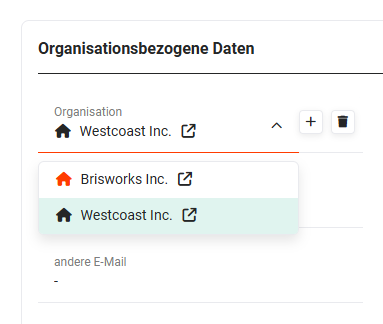 Example: two referenced organizations, primary relationship "Brisworks Inc."
The following functions are available in the Organization field:
| Function | Description |
|---|---|
| Make Primary Relationship (house icon) | Sets the selected organization as the primary relationship. The current primary relationship is recognizable by the highlighted house icon. |
| Open Organization (square with arrow icon) | Opens the linked organization in the detail view |
| Show Referenced Organizations (angle bracket icon) | Switches between the linked organizations; the organization-related fields update accordingly |
| Select Related Organization (plus icon) | Opens a popup to select an additional organization to link |
| Remove Related Organization (trash icon) | Removes the link to the organization; the organization record itself is not deleted |
Customer Portal Block
The Customer Portal block has three fields:
- Active?
- Support Start Date
- Support End Date
The "Customer Portal" block is used exclusively for functionalities of the Jira and Jira Service Management integrations.
3.2. Actions
The following actions are available in the detail view:
3.2.1. General Actions
- PDF Export
- Recommend
- Copy
- Delete
- Change Tracking
For detailed information on the actions, see the section Actions (Detail View).
3.2.2. Module-Specific Actions
| Action | Prerequisite | Functionality |
|---|---|---|
| Create Invoice | – | Creates a new invoice and links it to the contact |
| Generate QR Code (vCard) | – | Generates a QR code with the contact data as a vCard |
| New Document | – | Creates a new document and links it to the contact |
| Export vCard | – | Exports the contact data as a vCard file |
| Show Org Chart | – | Shows the org chart of the linked organization with the contact. Note: The displayed hierarchy refers exclusively to the client of the current record. Records of other clients are not taken into account. |
| New Task | – | Creates a new task and links it to the contact |
| New Appointment | – | Creates a new appointment and links it to the contact |
| New Email | Configured email inbox | Opens the email editor with reference to the contact |
| Unsubscribe from Email Marketing | Configured Email Marketing module | Unsubscribes the contact from email marketing |
| Send SMS | Configured Connect integration | Sends an SMS to a phone number stored in the record |
4. Practical Examples
1 – Creating and Managing a Contact Person for an Organization
A company gains a new customer. In the course of customer onboarding, the organization is first recorded in the Organizations module. The responsible contact person is then created in the Contacts module and linked to the organization via the Organization field. The organization-related fields – such as address, industry and phone – are automatically transferred from the organization and are directly viewable at the contact.
In the further course, deals, invoices and emails are directly linked to the contact. Via the Show Org Chart action, the structure of the linked organization with the contact can be displayed at any time. If the contact person leaves the company and moves to another customer, the existing organization link can be removed and a new one set – without having to create the contact record anew.
2 – Managing a Contact for Multiple Organizations
An external IT consultant is simultaneously working as a technical contact person for two customer companies. A single contact record is created and both organizations are linked via the Organization field as references.
One of the organizations is set as the primary relationship via the Make Primary Relationship icon – this organization determines the organization-related fields displayed by default. Via the Show Referenced Organizations icon, switching between the two organization contexts is possible, with the organization-related fields updating in each case. This way, the consultant is present with full context in both customer files without being recorded twice.
3 – Exporting and Sharing Contact Data
After a customer meeting, a field sales employee wants to transfer the contact person's data to their smartphone. In the detail view of the contact, a QR code with all relevant contact data is generated via the Generate QR Code (vCard) action, which can be scanned with the smartphone and saved directly as a contact.
Alternatively, a vCard file (.vcf) can be exported via the Export vCard action and forwarded by email or imported into an external address book. Both actions are available without further prerequisites in the detail view of the contact.
5. Frequently Asked Questions
Does a contact have to be linked to an organization?
No. A contact can also be recorded and used independently without a link to an organization – e.g., as a private individual or when the company affiliation is not yet known.
Can a contact be linked to multiple organizations?
Yes. The Organization field allows linking to multiple organizations simultaneously. One of them can be set as the primary relationship, which determines the organization-related fields displayed by default. Via the Show Referenced Organizations icon, switching between the linked organizations is possible.
What happens to organization data when two contact records are merged?
During the merge of duplicates, all organization references and organization-related field values of the primarily selected contact are always adopted. The organization-related fields of the second contact are not taken into account and are lost. It is therefore recommended to check which contact is selected as the primary record before merging.
What does the "Email Opt Out" toggle do?
When the Email Opt Out toggle is activated, no more automated emails are sent to this contact from the system – e.g., via automations. Manually sent emails are not affected.
What is the difference between "Email Opt Out" and "Newsletter Unsubscribed"?
Email Opt Out prevents automated email sending from brainX automations. Newsletter Unsubscribed causes the contact's email address to be ignored when adding to a recipient list in the Email Marketing module. Both toggles can be activated independently of each other.
How can I unsubscribe a contact from email marketing?
Via the module-specific action Unsubscribe from Email Marketing in the detail view of the contact, the contact is unsubscribed from email marketing. A configured Email Marketing module is required. Alternatively, the Newsletter Unsubscribed toggle can be activated manually.