
Special Module Settings
Package: BASIC SALES
1. General
For the modules
special module settings are available, as these modules have special functionalities.
2. Module Deals
For the Deals module, in addition to the four standard tabs
an additional tab "Product Block Settings" is available in Module Management.
Using the field Expand product block initially (toggle), it is defined whether the product block in the creation view is displayed initially expanded or collapsed. If the toggle is active, the product block is displayed expanded when a record is opened.
3. Module Delivery Notes
For the Delivery Notes module, in addition to the four standard tabs
an additional tab "Settings" is available in Module Management.
The settings items in the "Settings" tab will be modified in one of the upcoming brainX updates. It is recommended to already map warehouse management via a corresponding Automation.
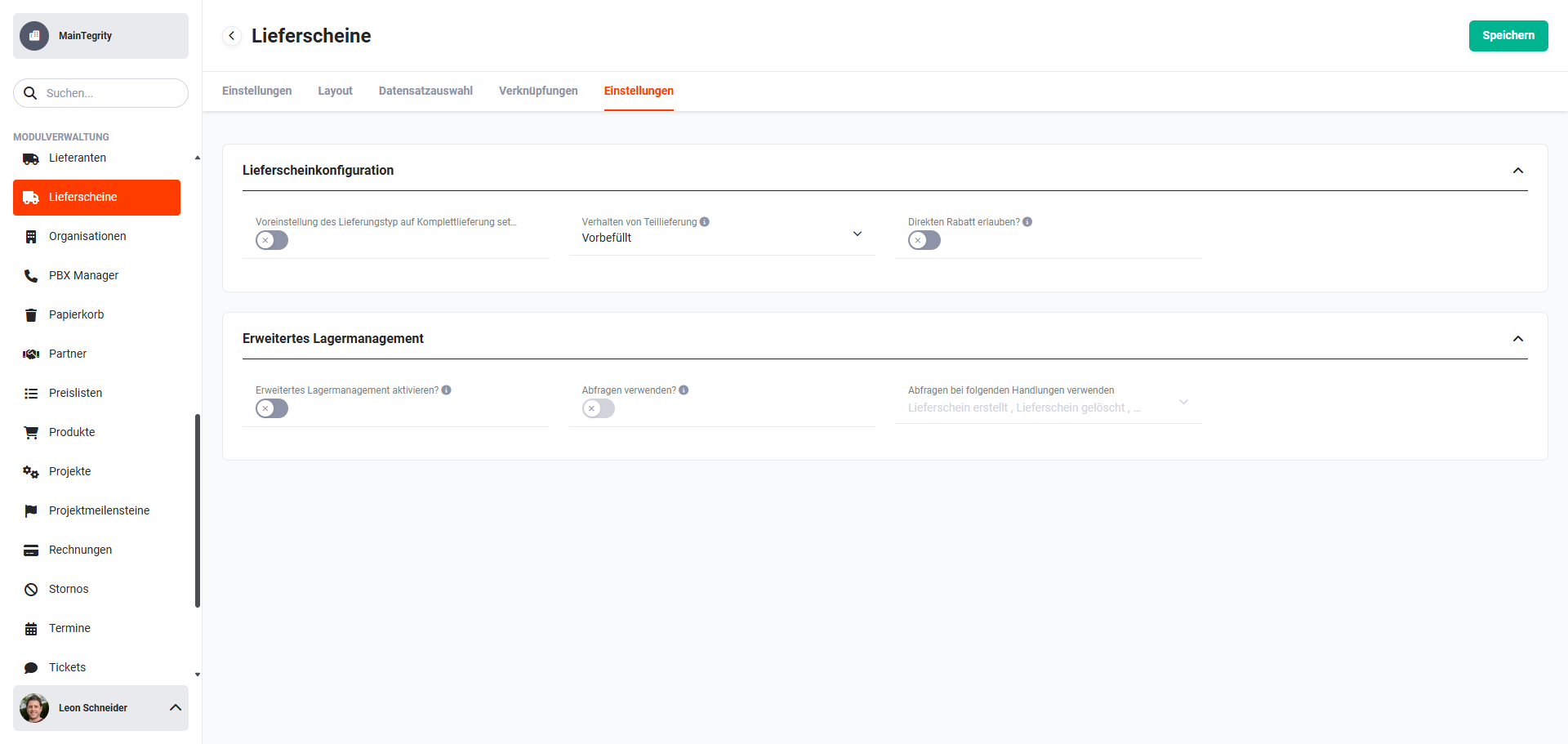 Module Management – Delivery Notes – Settings Tab
The "Settings" tab is divided into two blocks:
- Delivery Note Configuration → Settings for complete/partial delivery and discount
- Extended Warehouse Management → Settings for extended warehouse management
3.1. Delivery Note Configuration
The "Delivery Note Configuration" block contains the following fields:
- Set default delivery type to complete delivery → Sets the delivery type "Complete delivery" as the default value
- Partial delivery behaviour → Dropdown list with two values:
- Pre-filled → All quantity fields are preset to maximum
- Not pre-filled → All quantity fields are preset to empty
- Allow direct discount? → Enables/disables the direct discount in quotes (Deals) and Orders
3.2. Extended Warehouse Management
Extended warehouse management adjusts the stock quantity per product accordingly when the following actions are taken: delivery note creation, delivery note deletion, delivery note status change to cancelled or return, and quantity changes within the delivery note itself.
The "Extended Warehouse Management" block contains the following fields:
- Activate extended warehouse management? → Toggle to activate/deactivate extended warehouse management.
- Use queries? (field only editable when "Extended warehouse management" has been activated!) → The brainX system asks the user after the corresponding action whether the stock quantity of the involved products should change.
- Use queries for the following actions (field only editable when "Use queries?" has been activated!) → Dropdown list with the following values:
- Delivery note created
- Delivery note deleted
- Status: Cancelled
- Status: Return
- Quantity change delivery note
When extended warehouse management is activated, a popup with the query "By activating 'Extended Warehouse Management', the task 'UpdateInventory' will be globally deactivated" is displayed.
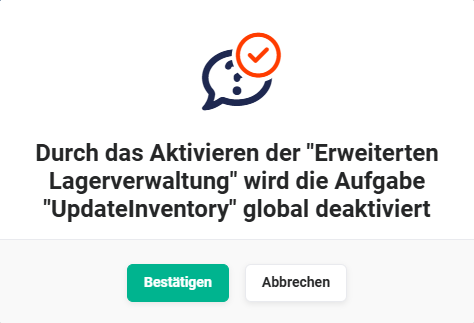 Popup Extended Warehouse Management
3.3. Stock Quantity Change Actions
The following actions reduce the stock quantity:
- Delivery note via the action "Create delivery note". After saving a record in the Delivery Notes module, the stock quantity is reduced by the quantity in the "Open" field in the product block for the respective product.
- The action "Create delivery note" is used in the following modules:
- Order + More Information
- Deal + More Information
- Delivery Note, after selecting the "based on" field
The following actions increase the stock quantity:
- In the delivery note, the status "cancelled" or "return" is set
- The stock quantity is increased for each product in the delivery note by the quantity in the "open" field
- Delivery note is deleted
The following actions change the stock quantity depending on the quantity:
- Quantity changes to a product in the Delivery Notes module
- The stock quantity is reduced/increased by the changed value in the "open" or "quantity" field accordingly.
- This check takes place after every save of a record.
- If the quantity of a product is less after editing a record, the warehouse quantity increases by the difference between the previous value and the value after saving.
- If the quantity of a product is higher after editing a record, the warehouse quantity decreases by the difference between the previous value and the value after saving.
4. Module Recycle Bin
For the Recycle Bin module, the standard configuration items Settings, Layout, Record Selection and Relations are not available!
However, Deletion Rules can be defined for the Recycle Bin module. Deletion rules allow you to specify whether and when records are automatically deleted from the Recycle Bin module.
Users who are "Admin" or "CustomerAdmin" according to Rights Management receive information about automatically performed deletion operations via system-internal Notifications.
4.1. Deletion Rules
Both a general deletion definition and a per-module deviating deletion definition can be configured.
If deletion definitions have been configured, the Background Task "Deletion routine" must be active! The background task automatically deletes records in the Recycle Bin module at the defined time interval.
When saving the deletion rules, all records older than the newly defined value are deleted from the Recycle Bin. The warning notice only appears when a change to a value greater than 0 is saved. If a value is set to 0 or a deletion rule is deactivated, no warning notice appears.
4.2. General Deletion Definitions
Field "Delete after days": Enter the number of days after which a record is removed from the Recycle Bin following deletion.
The value 30 is entered in the "Delete after days" field. All records that were deleted in modules more than 30 days ago are removed from the Recycle Bin when the deletion rules are saved.
To deactivate the automatic emptying of the Recycle Bin, the value 0 must be entered here.
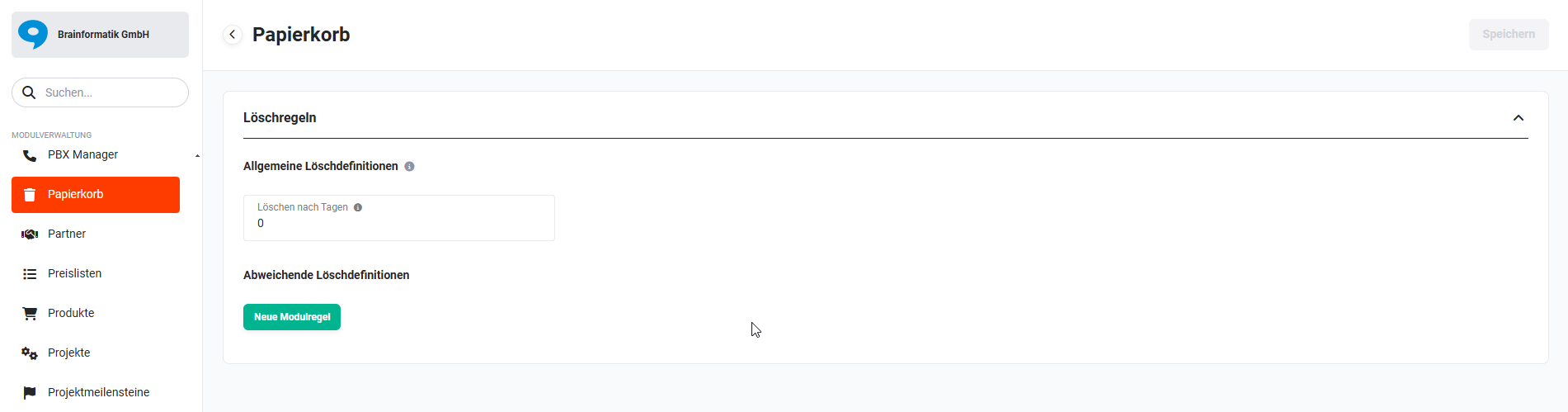 Module Manager – Recycle Bin Deletion Rules
4.3. Deviating Deletion Definitions
In addition to the general deletion definition, deviating deletion definitions per module can be configured, specifying after how many days records are automatically removed from the Recycle Bin.
After clicking the "New module rule" button, the "Module" field (dropdown list) and the "Delete after days" field are displayed.
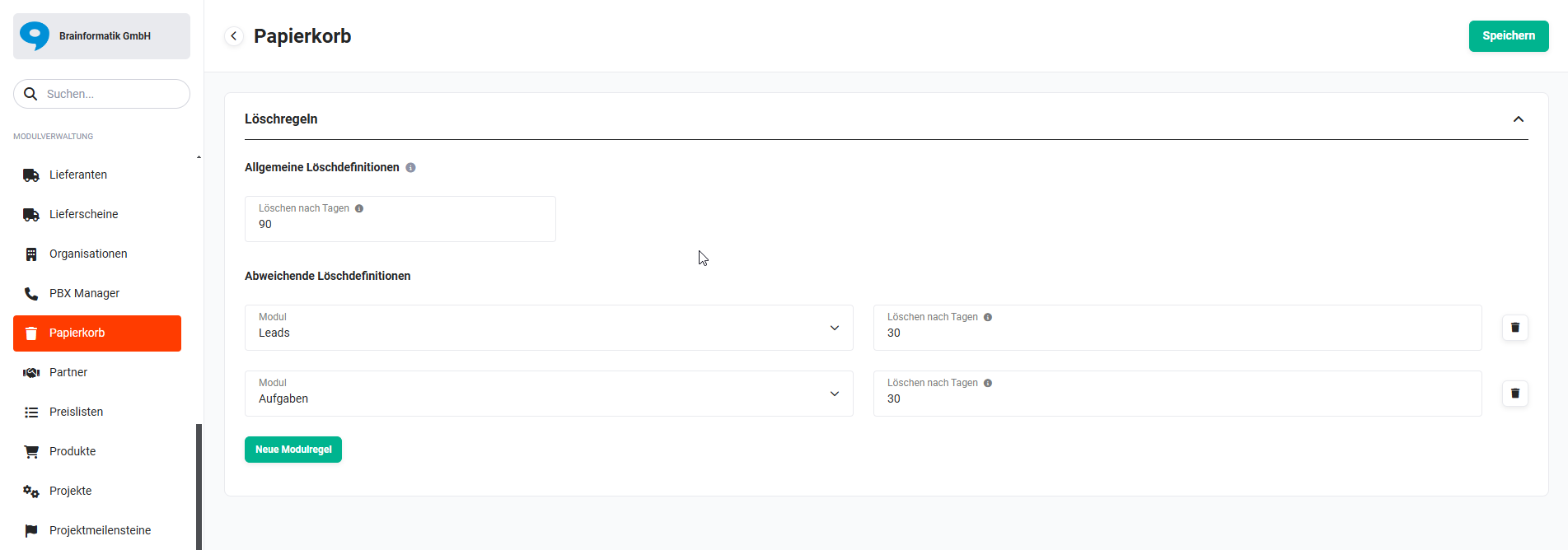 Module Manager – Recycle Bin – Deviating Deletion Definitions
- In the general deletion definitions, the value 90 is entered in the "Delete after days" field. All records for which there are no deviating deletion definitions are automatically removed from the Recycle Bin 90 days after deletion in a module.
- In the deviating deletion definitions (see screenshot above), the value 30 was entered in the "Delete after days" field for the Leads and Tasks modules. All records from the Leads and Tasks modules are automatically removed from the Recycle Bin 30 days after deletion in a module.
A deletion definition can also be configured for individual modules only, without setting a general deletion definition. To do this, simply enter the value 0 in the "Delete after days" field in the general deletion definition.
5. Module PBX Manager
In brainX, a telephony connection can be made via Sipgate or Softphone Connector.
After opening the PBX Manager module in Module Management, the tiles Sipgate and Softphone Connector are displayed in the "Telephone Provider" block.
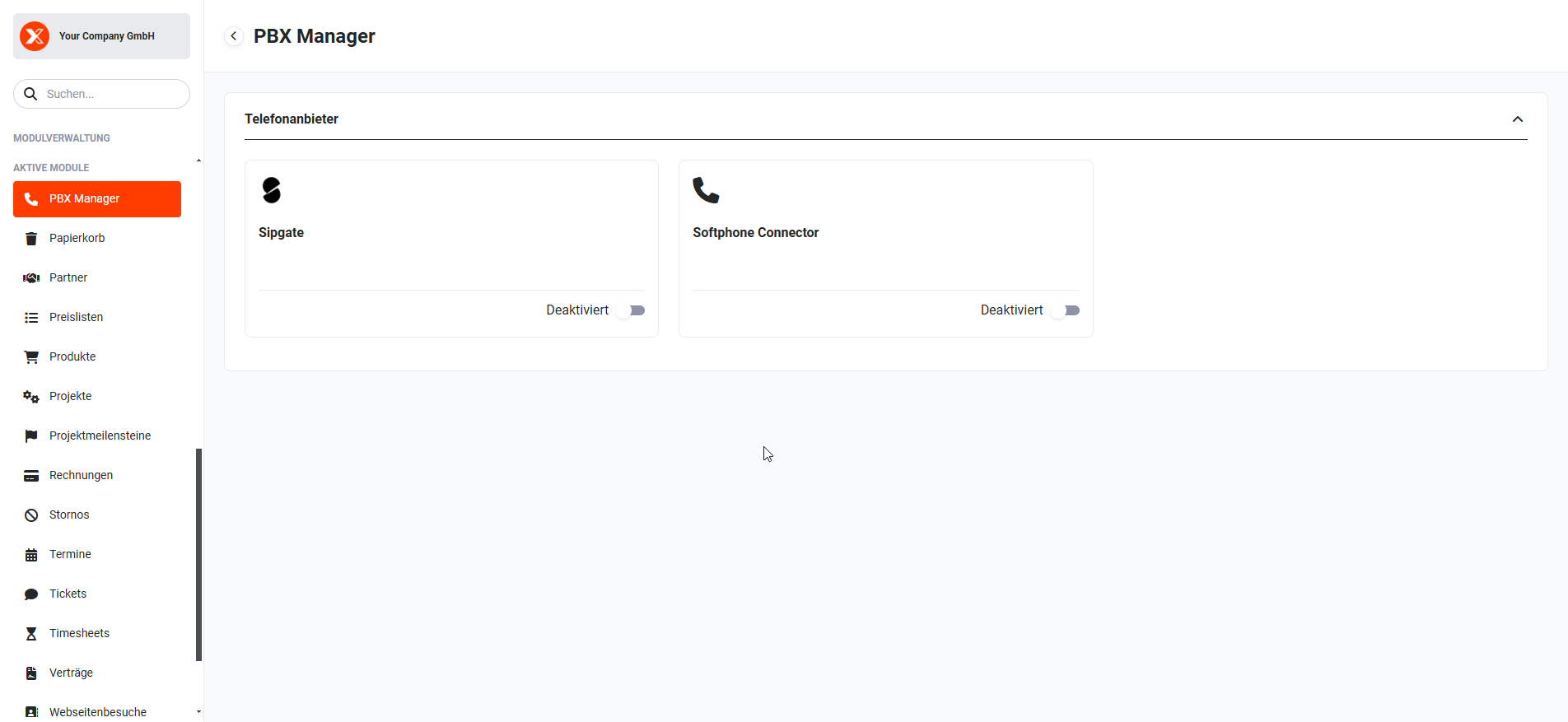 Module Management – PBX Manager
5.1. Sipgate
A user account at Sipgate and Sipgate.io is required for use!
To activate/configure the telephone provider Sipgate, the toggle within the tile must be activated.
The popup "brainX Endpoint" opens, displaying the endpoints for incoming and outgoing calls.
The endpoints must be stored in Sipgate.io.
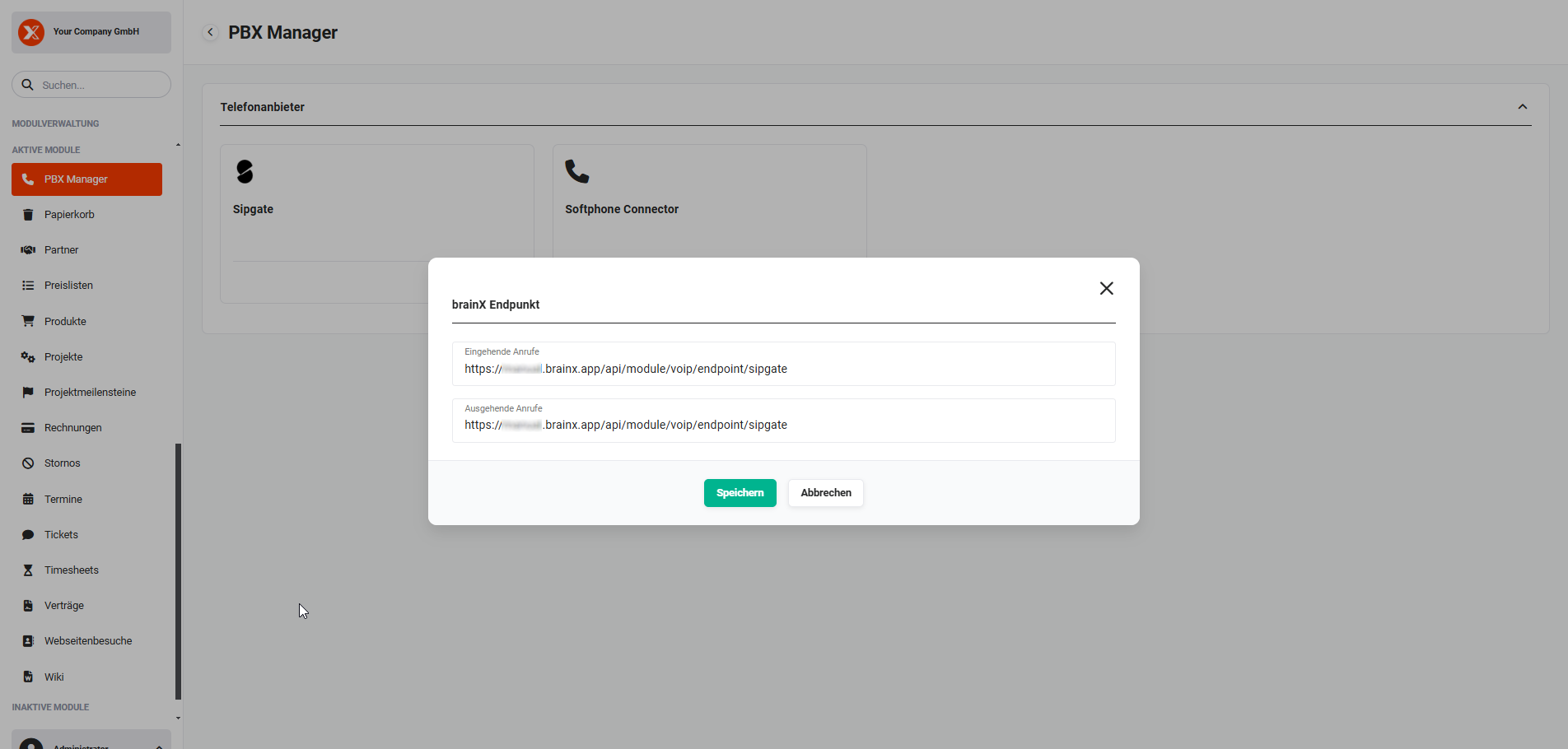 PBX Manager – Popup "brainX Endpoint"
To activate Sipgate in brainX, simply click the "Save" button in the popup "brainX Endpoint".
The PBX Manager module with the tile view in the Module Manager is now displayed again. The toggle is now set to "Activated" accordingly.
Each user who wants to use the telephony integration must enter their Sipgate data in My Preferences – Integrations – Softphone Connector.
The settings can also be made by a user with administrative rights in Global Settings – Users and Permissions – Users and Groups.
5.2. Softphone Connector
The following requirements apply for using the Softphone Connector:
- The soft client system (softphone or software telephone) used must be able to call a URL.
- Only available in the desktop version and not when using brainX on mobile.
- The user must be logged into brainX and the soft client must be active.
- Call contacts, organisations, leads, partners or suppliers with one click (outbound).
- Incoming calls are displayed as a popup with corresponding contact data (inbound).
- Call history with caller, call duration and call status (in- & outbound).
- Comments can be saved directly to the contact.
- Universally applicable: compatible with almost all telephone clients
To activate/configure the Softphone Connector, the toggle within the tile must be activated.
The popup "Softphone Connector" opens, in which the server settings are configured.
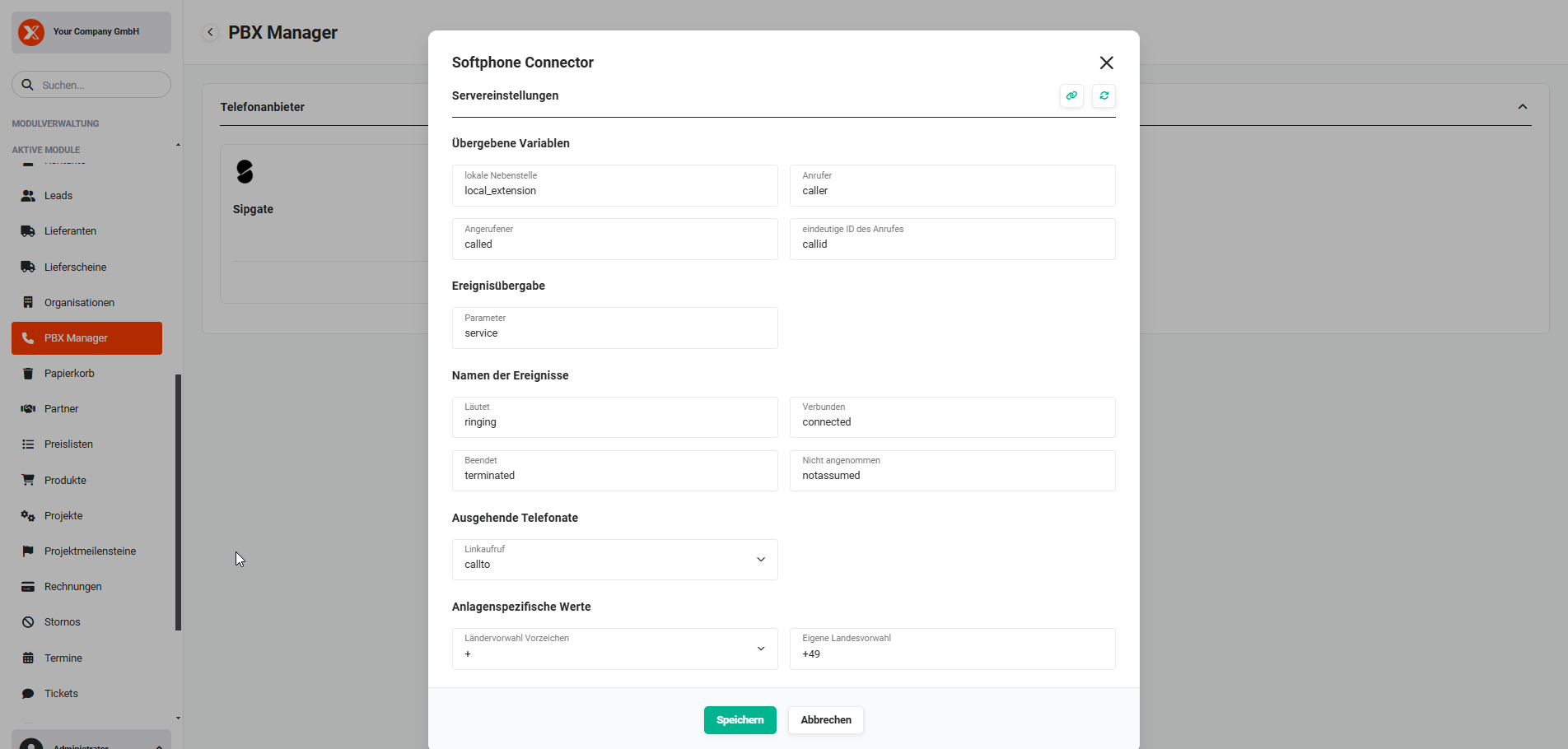 PBX Manager – Popup "Softphone Connector"
The popup "Softphone Connector" is divided into the following areas (including fields):
- Transferred variables
- Local extensions (default: local_extension)
- Caller (default: caller)
- Called (default: called)
- Unique call ID (default: callid)
- Event transfer
- Parameter (default: service)
- Event names
- Ringing (default: ringing)
- Connected (default: connected)
- Terminated (default: terminated)
- Not answered (default: notassumed)
- Outgoing calls
- Link call (dropdown list with values callto and tel, default: callto)
- System-specific values
- Country code prefix (dropdown list with values + and 00, default: +)
- Own country code (default: +49)
The following is expected as parameter per endpoint:
- The number of the local extension involved in the call.
- The number of the person called, with the area code for better readability.
- The unique ID of the call.
- The local extension for unique identification is stored in the User Settings of brainX.
The popup "Softphone Connector" also contains two additional action icons in the top right:
5.2.1. Client URL Examples
After clicking the button "Client URL Examples" (icon "chain links"), the popup "Client URL Examples" opens.
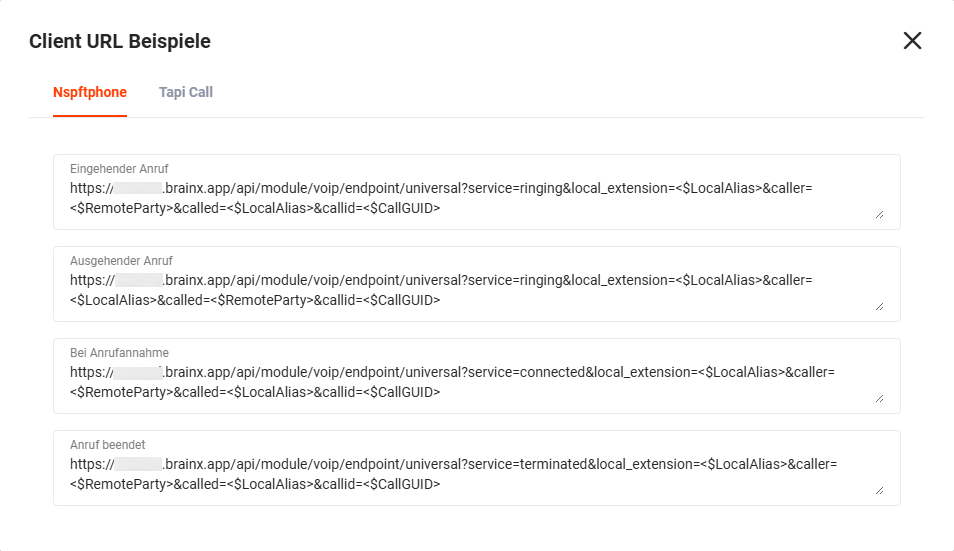 Popup "Client URL Examples"
The popup is divided into the tabs "Nsoftphone" and "Tapi Call", each containing URL examples for the following events:
- Incoming call
- Outgoing call
- On call acceptance
- Call ended
5.2.2. Default Settings
After clicking the button "Restore default settings" (icon "semicircular arrows"), all settings in the popup "Softphone Connector" are reset to the default settings.
5.2.3. Technical Call Flow
The integration is done via telephone soft client calls. The user's softphone client must be able to pass information to a URL when certain events occur.
5.2.3.1. Outgoing Calls
The user can initiate a call by clicking on the telephone number in the brainX system. The telephone soft client installed on the user's desktop computer must have a function that can respond to the transfer value from the browser. The user's telephone soft client must report a corresponding status back to the brainX system to generate a log entry in the system. If the called person was not reached or the conversation has ended, a status update must again be sent to the brainX system. In this case too, the information serves to update the log entries, e.g. to determine the call duration.
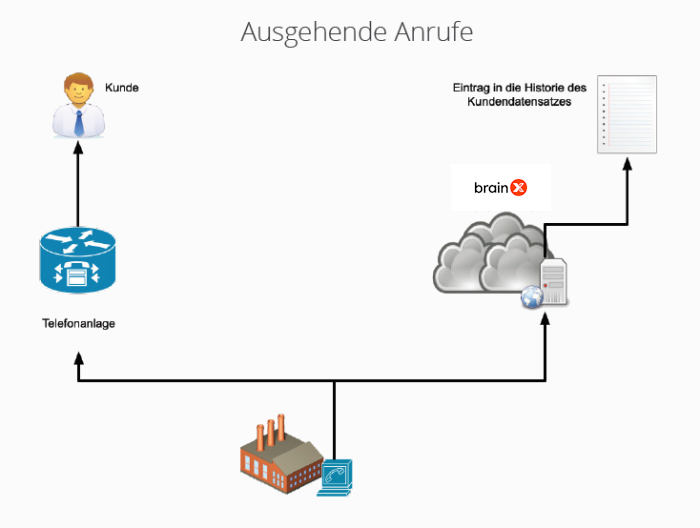 Schematic representation outgoing calls
5.2.3.2. Incoming Calls
Caller identification: Incoming calls must trigger a popup in the brainX system, in which all records with the corresponding number are displayed.
The user's telephone soft client rings. This information is transmitted to the brainX system. In the brainX system, matching leads, contacts, organisations and partners are displayed based on the transmitted telephone number.
In this case too, the call is logged. This also happens when the user does not answer the call. After the end of the conversation, a status is again sent to the brainX system. This data is used to update the call log.
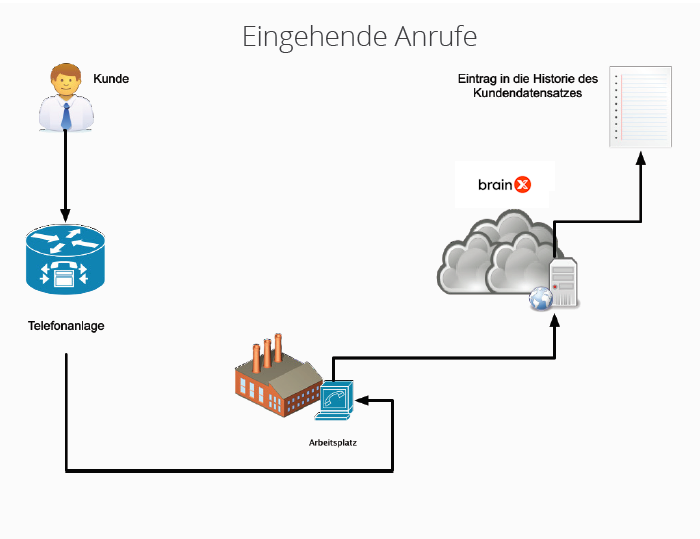 Schematic representation incoming calls
5.3. Background Task PBX Clean Up
The Background Task "PBX Clean Up" deletes PBX Manager entries that were initially created by the "Softphone Connector" integration but were never completed (i.e. filled with information). This happens, for example, when the user logs out of brainX before a call is completed.
Since an outgoing call already creates a record in the PBX Manager module when the telephone number is clicked, and this record is only updated at a later point in time, entries may exist that have not been maintained further.
To avoid accumulating more and more information-less entries with the status "Initial" over time, or entries that have no call duration, the background task "PBX Clean Up" is executed. It runs once per day and automatically deletes the corresponding records or moves them to the Recycle Bin.
If the "Softphone Connector" integration has been activated, the Background Task "PBX Clean Up" must also be active!
The background task "PBX Clean Up" is delivered initially configured to run once daily at 02:00. The settings of the background task cannot be changed. Instead of a user who deleted the record, the name of the background task is entered.
6. Module Appointments
The configuration settings for the Appointments module are described in the section Appointments – Basic Configuration.
7. Module Templates
For the Templates module, two settings areas are available:
- Standard → Configuration of columns in popups for selecting a template
- Module-specific exceptions → Exceptions to the columns configured in the "Standard" block. For the selected modules, the system standard is displayed in popups for selecting a template (columns Template name, Description and Responsible).
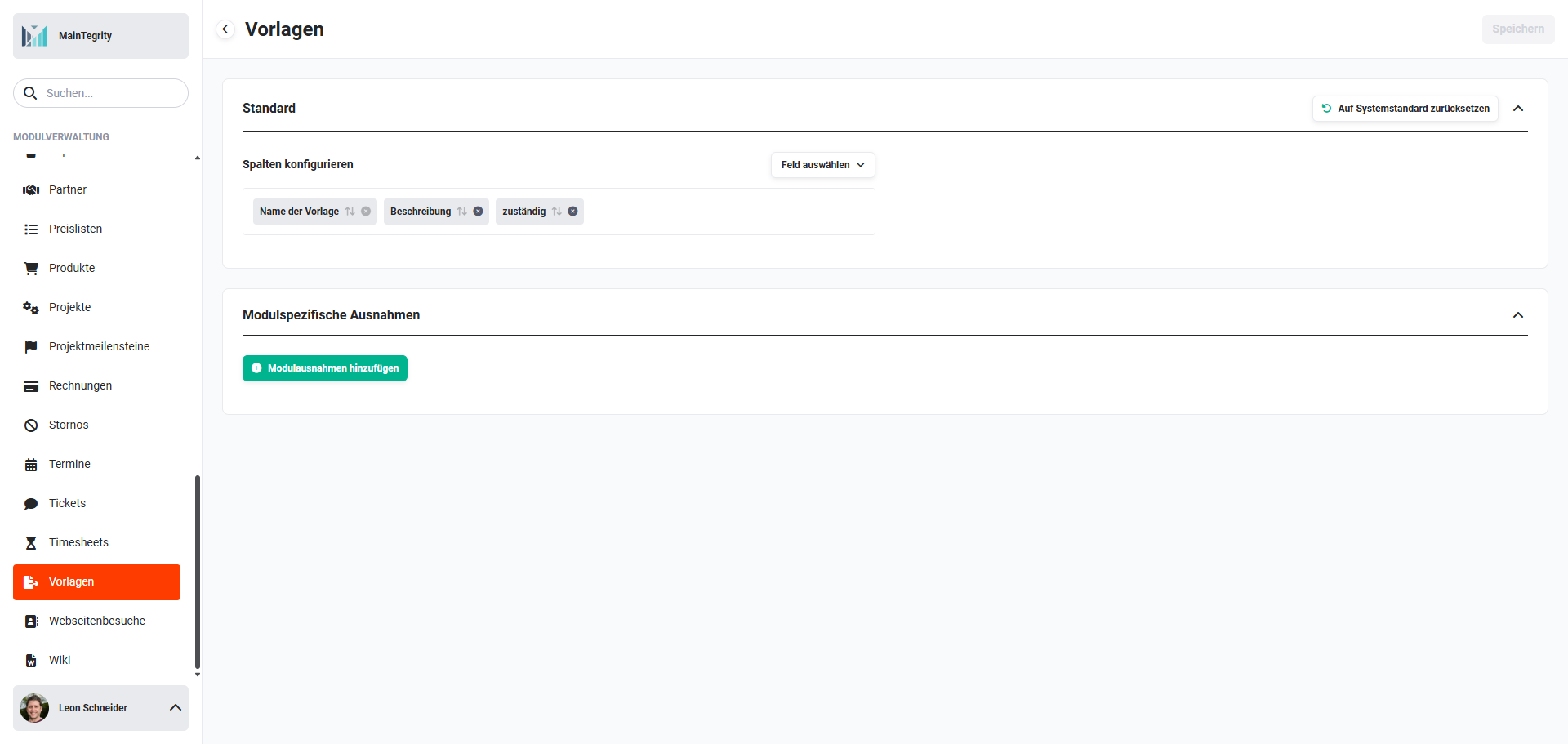 Module Management Templates
8. Practical Examples
1 – Recycle Bin: different retention periods per module
A company wants deleted contacts and organizations retained for 90 days, but leads and tasks permanently deleted after 30 days. In the general deletion definitions, the value 90 days is entered. Using New Module Rule, two separate rules are created for Leads and Tasks with a value of 30 days. The background task Deletion Routine is configured to run daily and is set to active.
2 – Deals: always show product block expanded on open
The sales team wants the product block to be immediately visible when creating a new deal, without having to expand it manually. In the module management of the Deals module, the Product Block Settings tab is opened and the toggle Expand product block initially is enabled. From this point on, the product block is automatically shown expanded in the creation view.
3 – Delivery Notes: automatically reduce stock quantity
A company wants the stock quantity of the affected products to be automatically reduced when a delivery note is created. In the module management of Delivery Notes, extended warehouse management is enabled. The option Use queries? is activated and Delivery Note Created is selected as the trigger event. When the next delivery note is saved, the user is asked whether the stock quantity should be adjusted accordingly.
9. Frequently Asked Questions
What happens to records already in the Recycle Bin when a deletion rule is saved?
When saving, all records in the Recycle Bin that are older than the newly defined value are immediately and permanently deleted. The warning message only appears for values greater than 0. Records that are younger than the new value are retained.
Does the "Deletion Routine" background task need to be activated separately?
Yes. Deletion rules alone have no effect if the Deletion Routine background task is inactive. It must be active and configured to run on a reasonable interval (e.g. daily) for the automatic Recycle Bin cleanup to take place.
What is the difference between a general and an overriding deletion definition?
The general deletion definition applies to all modules for which no overriding rule is configured. Overriding deletion definitions allow a different retention period to be set for individual modules — e.g. delete leads after 30 days while all other modules retain records for 90 days.
Can extended warehouse management be used simultaneously with the "UpdateInventory" background task?
No. When extended warehouse management is enabled, the UpdateInventory background task is automatically deactivated system-wide. Both mechanisms manage stock quantities and must not be active at the same time.