
Products
Package: BASIC
1. General
Records from the Products module are selectable in the so-called "product block". For detailed information, see the section Product Block in Billing Modules in the manual.
A company sells network switches. The product is created with the Product Category Hardware, a Sales Price and the Unit of Measure Unit. The current Stock Level is entered and a Minimum Stock is set. An automation ensures that a purchase order is automatically created when the minimum stock is undershot.
A software license is created as a product with the Price Type Annual Price. For volume discounts, a pricing tier is configured: 1–9 units at EUR 95, 10–19 units at EUR 89, 20+ units at EUR 79. In the product block, the appropriate tiered price is automatically applied when the quantity is entered.
This section only describes special fields or functionalities of the module, as all general brainX functionalities are described elsewhere in the manual.
2. List View
The list view in the Products module has the usual functionalities of a list view. For more detailed information, see the section Structure/Layout – List View.
2.1. Actions
In the list view, general actions are available depending on the module. An overview and description of all general actions can be found in the section Actions (List View).
There are no module-specific actions in this module.
3. Detail View
3.1. Fields
The following table describes required fields and fields with non-obvious functions. All other fields are self-explanatory.
Basic Data Block
| Field | Description |
|---|---|
| Product * | Name of the product |
| Active | When deactivated, the product is no longer available for selection in the product block |
| Product Category |
|
| Product Bundle | Automatically set as soon as individual products have been added under Product Bundles in the Relations tab. Only visible in the detail view, not in the edit view – see Section 3.3. |
| Gross Price | When activated, the entered price is treated as a gross price |
| Surcharge monthly / quarterly / semi-annually / annually | Optional percentage surcharge per billing interval; applied to the base price in the product block when the corresponding interval is selected |
| Price Type * |
|
| Required Position | When the checkbox is activated, this position must be confirmed by the recipient when signing via Digital Signature (DocuSign/DocuSeal). Required positions are marked accordingly in the document. |
*Required field
The Price Type defines the period to which the stored sales price refers:
- Annual Price – the price applies per year; if the product is inserted into a product block with a different billing interval (e.g., monthly), the price is automatically converted to the selected interval.
- Monthly Price – the price applies per month; with a different billing interval in the product block, the price is converted accordingly.
- One-time – the price is charged exactly once regardless of an interval; no conversion takes place.
Quantity, list price and sales prices of positions in the product block can be entered with up to 6 decimal places. Trailing zeros are truncated in the display. This is particularly helpful when billing small units (e.g., API tokens).
If the Gross Price toggle was activated when creating a product, this cannot be changed after the first save.
Prices Block
| Field | Description |
|---|---|
| Sales Price | Sales price of the product in the base currency. Via the additional currencies actions icon, additional currency prices can be stored – see Section 3.1.1. |
| VAT Level | Assigned VAT level – see Global Settings – Currencies & Taxes |
3.1.1. Additional Currencies
The additional currencies actions icon is only available in the create and edit view. After clicking it, the popup of the same name opens.
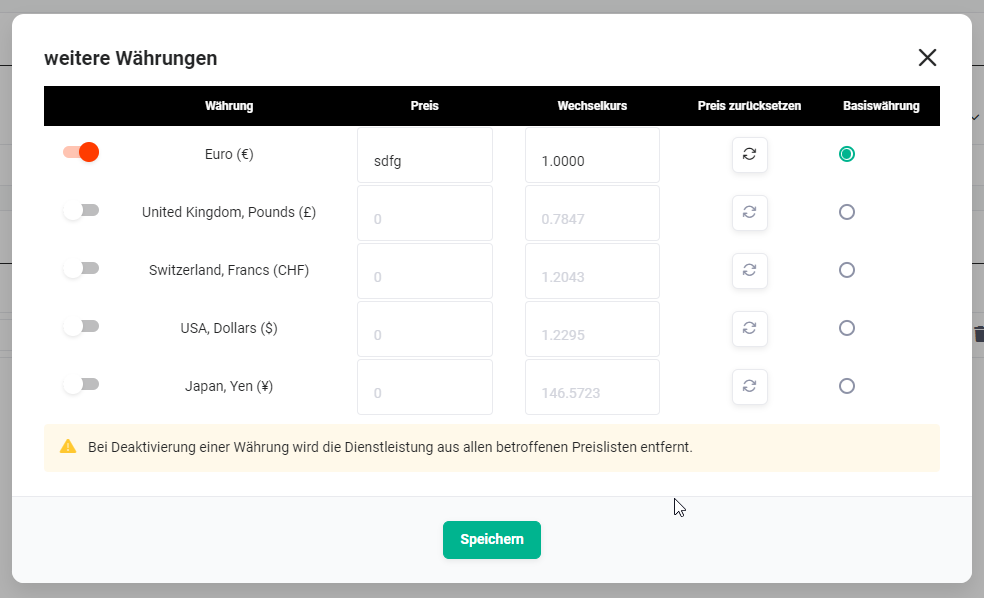 Additional Currencies popup
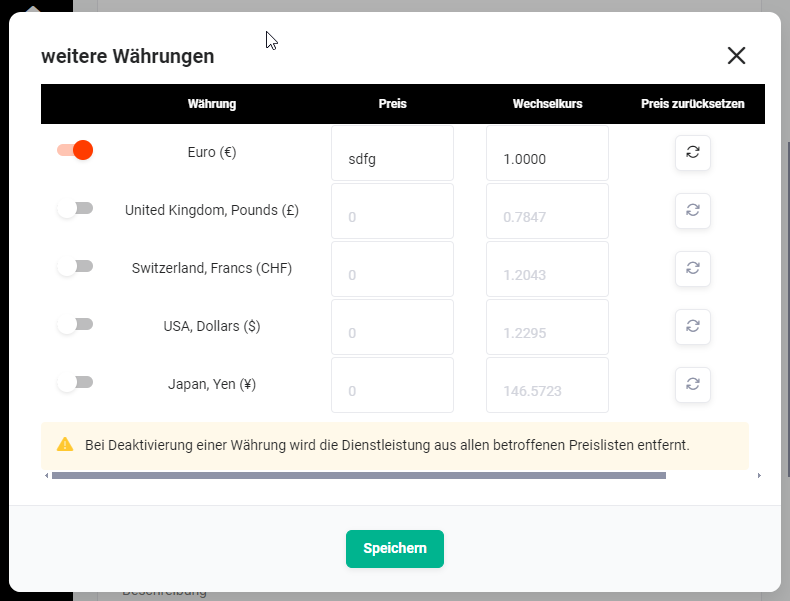 Additional Currencies popup
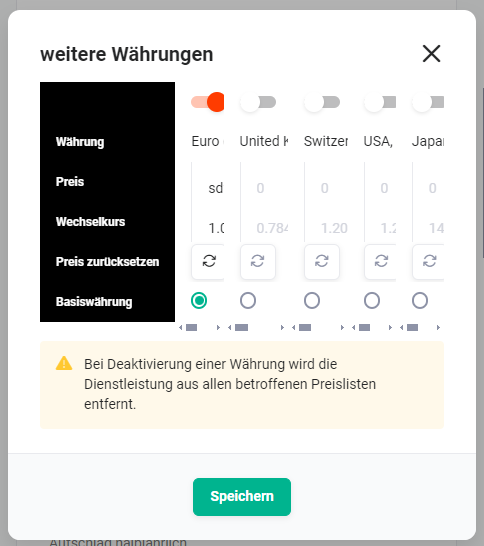 Additional Currencies popup
In the popup, all currencies are listed that have the active status in Global Settings – Currencies & Taxes. A checkbox defines which currencies are available for the product. A radio button defines the base currency. For all activated non-base currencies, the respective price can be automatically calculated based on the stored exchange rate via the recalculate button.
After saving, the price is displayed in the currency stored in Personal Settings – Basic Settings.
When a currency is deactivated, the product is removed from all affected price lists.
Inventory Block
| Field | Description |
|---|---|
| Unit of Measure |
|
| Stock Level | Current stock level of the product |
| Minimum Stock | Lower limit of the stock level; can be used in an automation as a trigger to send a notification or create a purchase order when undershot |
| Reorder Quantity | Standard quantity for reorders; can be used in an automation |
| Weight in KG | Weight of the product; used to calculate the total weight of a line item |
To activate the weight calculation, the by-default hidden Total Weight Position field must be displayed in Global Settings – Additional Settings – Product Block – see also revision-safe and optional fields for product positions. In all billing modules, there is additionally the Total Weight of All Positions field that can be displayed in custom views as needed.
Via automations, the stock level can be automatically updated: reduced when a delivery note or an invoice is created, and increased when a purchase order is created.
DATEV General Ledger Accounts Block
| Field | Description |
|---|---|
| DATEV General Ledger Account Domestic | General ledger account for domestic revenues – configuration see Billing Settings – General Ledger Accounts |
| DATEV General Ledger Account EU | General ledger account for EU revenues – configuration see Billing Settings – General Ledger Accounts |
| DATEV General Ledger Account Third Countries | General ledger account for revenues in third countries – configuration see Billing Settings – General Ledger Accounts |
Pricing Tiers Block
A pricing tier can be defined for a defined unit of a product. Any number of tiered prices can be created. A new tiered price is defined in edit mode via the Add Tier button.
For the first 9 units of a product, EUR 95 is charged. For 10–19 units, the unit price drops to EUR 89, for 20–49 units to EUR 79.
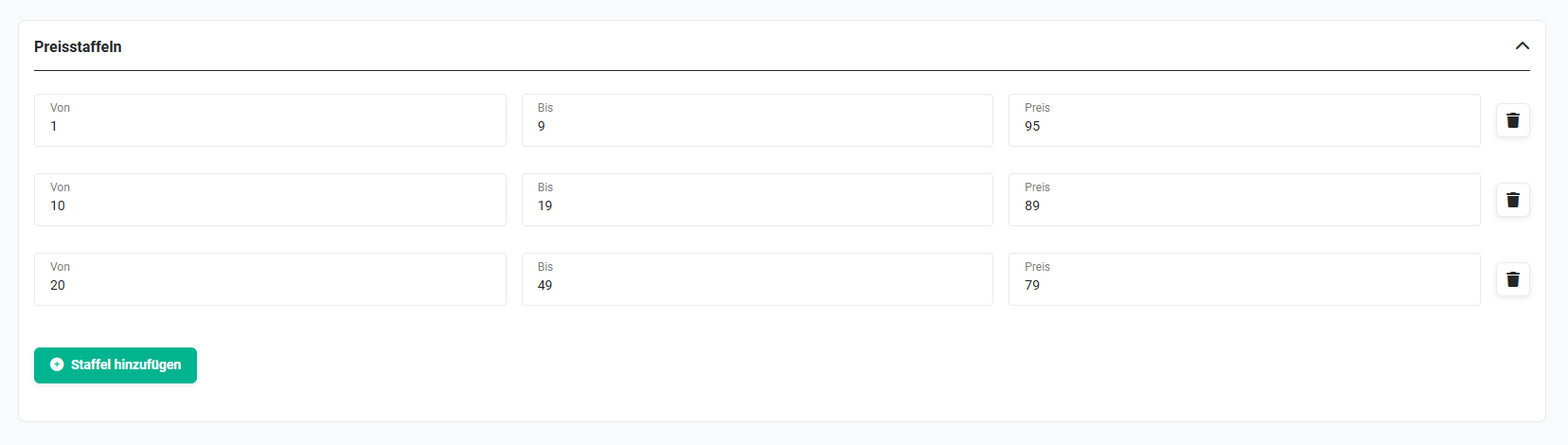 Editing pricing tiers
3.2. Actions
The following actions are available in the detail view:
3.2.1. General Actions
- PDF Export
- Recommend
- Copy
- Delete
- Change Tracking
For detailed information on the actions, see the section Actions (Detail View).
3.2.2. Module-Specific Actions
| Action | Prerequisite | Functionality |
|---|---|---|
| New Email | Configured email inbox | Opens the email editor with reference to the product |
3.3. Product Bundles
Multiple products can be combined into a product bundle. A product bundle consists of any number of individual products, each of which must exist as its own record in the Products module. As soon as individual products have been added, the Product Bundle field in the Basic Data block is automatically set.
The sales price of a product bundle is not automatically calculated and must be manually entered in the "Sales Price" field.
Adding Products to a Product Bundle
Adding individual products is done in the detail view via the Relations tab with the following actions icons:
| Actions Icon | Functionality |
|---|---|
| Select Products | Opens a popup to select one or more existing products; individual selection by clicking the name or multiple selection via checkbox and Select button |
| Create Product | Creates a new product and adds it directly to the product bundle |
Usage in the Product Block
A product bundle is added in the product block – e.g., in the Deals and Invoices modules – like any other product. In the edit view of a record, all individual products contained in the product bundle are displayed.
4. Practical Examples
1 – Creating a Hardware Product with Inventory Management and Automatic Reordering
A company sells network switches. The product is created in the Products module with the Product Category Hardware, the Unit of Measure Unit and the Price Type One-time. The current Stock Level is entered and a Minimum Stock of 5 units and a Reorder Quantity of 20 units are defined.
An automation is configured so that it automatically creates a purchase order for the defined reorder quantity from the responsible supplier when the minimum stock is undershot. Additionally, another automation automatically reduces the stock level as soon as a delivery note or invoice for this product is created. This way, the stock level is always up to date and reorders occur without manual intervention.
2 – Configuring a Software Product with Tiered Pricing and Multiple Currencies
A software license is to be offered with quantity-dependent prices and in two currencies. The product is created with the Price Type Annual Price. In the Pricing Tiers block, three tiers are configured: 1–9 units at EUR 95, 10–19 units at EUR 89 and 20+ units at EUR 79.
Via the additional currencies actions icon, prices in USD are additionally stored and automatically calculated based on the current exchange rate via recalculate. In the product block of an order or invoice, the appropriate tiered price is automatically applied when the quantity is entered – depending on the currency in which the billing record was created.
3 – Assembling a Product Bundle from Multiple Individual Products
A company offers a starter package consisting of three individual products: hardware, software license and installation service. All three products are already maintained as standalone records in the Products module.
In the Products module, a new record Starter Package is created. In the Relations tab, all three individual products are added to the bundle via Select Products. The Product Bundle field is automatically set. The sales price of the bundle is manually entered in the Sales Price field. In the product block of a deal or invoice, the bundle is added like a normal product – all contained individual products are displayed in the edit view.
5. Frequently Asked Questions
Can I change the Gross Price toggle after saving?
No. If the Gross Price toggle was activated when creating a product and the record was saved, this setting cannot be changed. It is therefore recommended to carefully review the price type before the first save.
How is the stock level automatically updated for delivery notes and invoices?
The stock level is not automatically adjusted by the system, but is controlled via automations. An automation can be configured so that the stock level is reduced when a delivery note or invoice is created and increased when a purchase order is created. Detailed information can be found in the section Automations.
What happens to a product when it is deactivated?
When the Active toggle is deactivated, the product is no longer available for selection in the product block of billing modules. The record remains in the system and can be reactivated at any time.
Can I offer a product in multiple currencies?
Yes. Via the additional currencies actions icon in the create or edit view, additional currency prices can be stored. The prices can be entered manually or automatically calculated based on the stored exchange rates via the recalculate button. When a currency is deactivated, the product is automatically removed from all affected price lists.
Is the sales price of a product bundle automatically calculated?
No. The sales price of a product bundle is not automatically summed from the individual prices of the contained products – it must be manually entered in the Sales Price field.
What are the DATEV general ledger accounts in a product used for?
The DATEV general ledger accounts (Domestic, EU, Third Countries) control which booking account is used during the DATEV export of invoices that contain this product as a line item. The available general ledger accounts are configured in Billing Settings – General Ledger Accounts.